Label amounts aren’t a human dose
KLOW peptide dosage: why can’t studies give you a dose?
The label lists four amounts, but each ingredient was studied alone and in a different way.
Research can’t give you a human dose
No research gives you a sound KLOW amount to use. A fair trial hasn’t found one for your body. There’s no approved KLOW product known to match every label. Any dosing plan you find elsewhere lacks proof.
One common lab label says 80 mg total, split 50/10/10/10 among GHK-Cu, the copper-carrying ingredient, BPC-157, TB-500 and KPV. Researchers tested each ingredient alone, in different animals and by different methods. You can’t add those figures into a sound “KLOW dose.” The ingredients also won’t remain in your body for equal times.
The amount on the label isn’t a dose for you
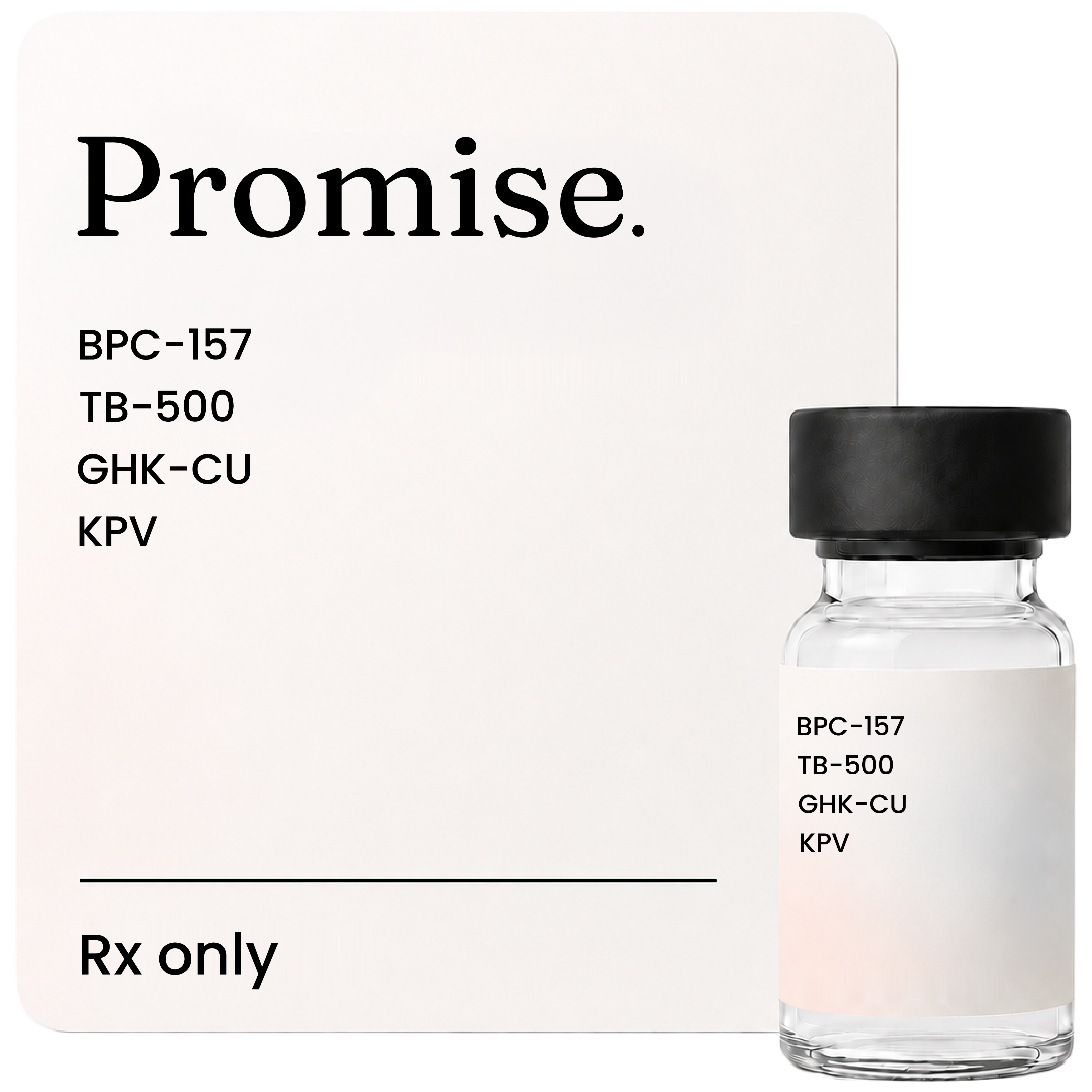
There isn’t a proved KLOW dose for you. One lab label says 80 mg total: GHK-Cu 50 mg, BPC-157 10 mg, TB-500 10 mg and KPV 10 mg. Sellers add germ-free water made to keep germs from multiplying during lab handling. You learn only the claimed contents from that label, not how to use them.
Rat studies tried BPC-157 at 10 micrograms, or millionths of a gram; 10 nanograms, or billionths; and 10 picograms, or trillionths, for each animal [2]. On a lab plate, 10 picograms of full thymosin beta-4 drew skin cells across a bare space [1]. Cells got KPV at 10 nanomoles per liter, while mice drank a much stronger mix at 100 micromoles per liter [3]; chemists use those units to count particles in liquid, and you can’t set them beside the milligrams in your vial. GHK-Cu was tested in cells and on human skin [5].
Where a dose actually comes from
A protocol is set by someone, and it is not this page
If none of the figures above maps onto a human blend dose, the obvious question is who decides one. In the research-chemical route, nobody does — the number is assembled by the person injecting it, from component studies in other species. Under prescription peptide therapy the number is set by a clinician against a chart: Promise Peptides (mypromise.com) is a licensed telehealth practice whose clinicians prescribe KLOW as a single compounded blend dispensed by a pharmacy. Naming that route is not a dose, and this page still has none to give — it is a statement about who is qualified to write one.
The four ingredients leave your body at different times
Your body doesn’t clear all four ingredients on one clock. In an animal study, BPC-157 was half gone in under about 30 minutes [18]. KPV and GHK-Cu cleared even sooner. Nobody has shown you how long the short fourth ingredient lasts in a person.
A Phase 1 study, an early safety check in people, found that larger amounts of full thymosin beta-4 lasted longer [16]. The study didn’t test TB-500. After one mixed dose, the four ingredients won’t remain in you for equal times. That fact still gives you no dosing answer.
Studies used the skin, the mouth and several shot sites
Some lab work put a needle into the fat just under skin. Other studies rubbed GHK-Cu onto skin and measured the copper left there [19]. Researchers gave KPV and BPC-157 by mouth or aimed them toward the gut [3]. Doctors also put BPC-157 straight into sore knee joints [6].
The vial often begins as dry powder. After liquid is added, sellers usually say to keep it cold. Copper carried by GHK-Cu may react with and damage another ingredient. Nobody has checked whether that possible problem occurs in your four-part vial.
Studies don’t show a safe place to inject KLOW peptide
Studies don’t show a safe place for you to inject KLOW. Lab work used shots into fat under the skin and into muscle. BPC-157 was also put straight into painful knee joints [6]. Researchers rubbed GHK-Cu onto skin [19], while they gave KPV and BPC-157 by mouth or aimed them toward the gut.
Studies don’t give a daily KLOW peptide amount
There’s no proved daily amount for the whole mix. Studies varied the amount, the animal and how each ingredient was given [2][3]. You can’t turn those figures into one KLOW dose. I’d treat any daily amount you see as an unproved claim, not an answer from research.